

In short: For misprinted or obsolete packaging stock, the answer is often “both”. Packaging disposal protects your brand, and recycling recovers the material. If the packaging has not yet reached the market, the Regulation on the Control of Packaging Waste does not cover it. The right route is to shred the packaging at a licensed facility, send it to recycling, and document every step.
A batch of boxes arrives from the printer with the wrong barcode. A campaign ends, and boxes with the old logo stay in the warehouse. A label changes, but the old stock still sits on the pallet. Should you throw these packages away, give them to a scrap dealer, or send them to recycling? This article explains the difference between packaging disposal and recycling, and the right order for packaging disposal.
Why is faulty or old packaging risky?
Printed packaging is more than a box. It carries the face of your brand. If packaging with a wrong barcode, an old date, or wrong ingredient information meets a product, it misleads the consumer. Packaging that leaves your control can also make a counterfeit look more convincing. We explained this risk in our article on protecting brand value during disposal.
So the question is not only “where does the waste go”. It is also “who gets the print”.
Does the Packaging Waste Regulation cover this stock?
The regulation covers all packaging placed on the market and the waste from that packaging (Article 2(1)). Packaging that nobody has placed on the market, and its waste, stays outside the regulation (Article 2(2)). So a misprinted stock that has not yet reached the market together with a product does not fall under this regulation.
Once this stock becomes waste, the general waste rules apply. In addition, the regulation asks packaging waste producers to follow the Waste Management Regulation and the Zero Waste Regulation when they accumulate, temporarily store, hand over, transport, and recover packaging waste (Article 19(1)). You can read the details on our Regulation on the Control of Packaging Waste page.
Packaging disposal or recycling?
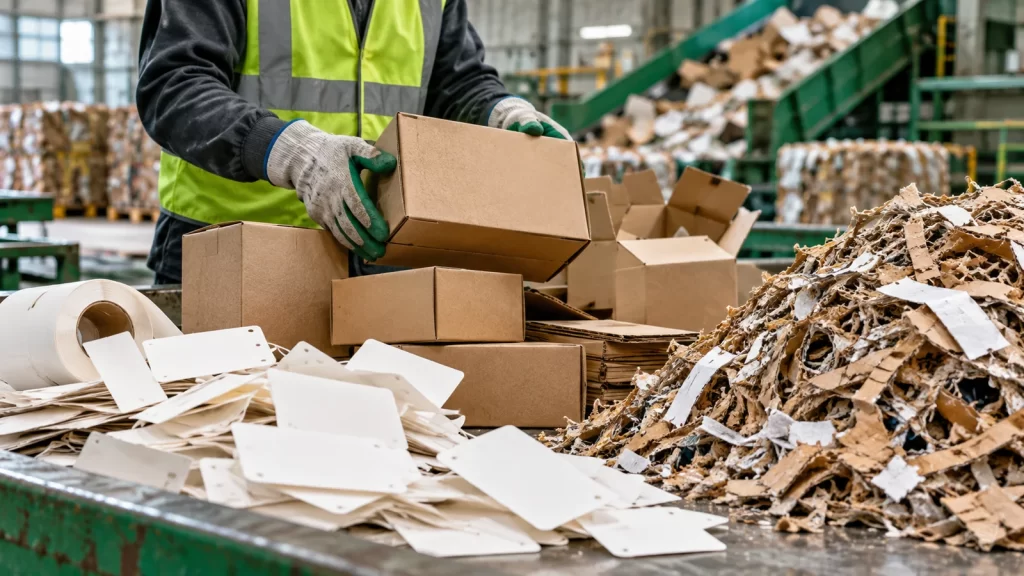
The two routes do not compete. The Waste Management Regulation defines recycling as a recovery operation that reprocesses waste into products, materials, or substances. In a well-run packaging disposal process, the facility first shreds the packaging. As a result, the print becomes unreadable. Then the material goes to recycling. In other words, you destroy and recover the packaging at the same time.
The packaging regulation points the same way. For packaging waste, material recycling comes first. If material recycling is not economically or technically possible, and no other recovery route works, the waste goes to an environmentally licensed facility for energy recovery (Article 20(2)).
Ask yourself these questions when you decide:
- Is the information correct? If the packaging carries a wrong barcode, date, or ingredient list, never reuse it.
- Is the design still valid? An old design that still carries current and correct information can serve your product.
- Is the material a single type? A composite package is an integrated package whose materials people cannot separate by hand (Article 4(r)). This structure makes recycling harder.
- Is the brand risk high? Have high-risk stock shredded, with a count, a seal, and a record.
Does the recovery contribution fee (GEKAP) apply to this stock?
The GEKAP rules sit in the Regulation on the Recycling Contribution Fee. The regulation applies the fee only to products placed on the domestic market (Article 5(2)). Exported products fall outside its scope (Article 2(2)(a)). For this reason, check your declarations and payments together with your accountant.
Which waste rules govern packaging disposal?
In packaging disposal, as a packaging waste producer, you follow the Waste Management Regulation. The regulation asks you to do the following (Article 9(1)):
- Collect the waste separately and store it temporarily.
- Keep records of the waste, and pack and label it properly.
- Send the waste to a facility that holds a permit or an environmental license.
- Fill in the previous year’s waste declaration form online by the end of March each year, and keep a copy for five years.
In addition, the records must state the waste type, code, quantity, source, and the facility it went to. Producers and facilities keep them for at least five years (Article 15).
How does packaging disposal work step by step?
- Inventory: First, you list the stock by material type, quantity, weight, and cause of the defect. You write composite packaging on a separate line.
- Decision: Then you choose reuse, recycling, or disposal. Packaging with wrong information never goes back into reuse.
- Brand check: You plan for the stock that carries a logo or barcode to become unreadable.
- Sealed transport and weighing: You send the packaging to the facility with a count record, in a sealed vehicle. The facility issues a weighing document.
- Documentation: Finally, you put the disposal or recycling record, the weighing document, and the photos in your file.
The way to write off the cost of the stock depends on the condition of the packaging. We explained the legal route for loss of value in our article on lost goods versus impaired goods. In its packaging waste disposal service, Scrap runs shredding, recycling, and documentation together.
Frequently asked questions
Can I give misprinted packaging to a scrap dealer?
Not if the dealer is unregistered and unlicensed. The regulation requires you to send waste to a facility that holds a permit or an environmental license (Waste Management Regulation, Article 9(1)(g)). Moreover, printed packaging in other hands can serve a counterfeit.
Does recycling also count as destruction?
From a brand point of view, yes, in a well-run process. The facility shreds the packaging, and the print becomes unreadable. The Waste Management Regulation defines recycling as a recovery operation that reprocesses waste into new products, materials, or substances.
Does the Packaging Waste Regulation cover this stock?
Packaging that nobody has placed on the market, and its waste, falls outside the regulation (Article 2(2)). Once the stock becomes waste, the Waste Management Regulation applies.
Do I have to pay GEKAP?
The regulation applies the contribution fee only to products placed on the domestic market (Article 5(2)). Exported products fall outside its scope (Article 2(2)(a)). Check your declarations with your accountant.
Sources
- Regulation on the Control of Packaging Waste (Official Gazette, June 26, 2021, No. 31523), Articles 2, 4, 19, and 20
- Regulation on the Recycling Contribution Fee (Official Gazette, December 31, 2019, No. 30995 fourth bis), Articles 2 and 5
- Waste Management Regulation (Official Gazette, April 2, 2015, No. 29314), Articles 4, 9, and 15
This article follows the legislation in force on its publication date. It is for general information and does not replace tax advice. Therefore, get your accountant’s opinion before you act. If you want to plan the process for your stock together with us, you can fill in our request form.
İmha Sürecinizi Planlayalım
Vergi avantajı takvimi ve imha süreciniz hakkında ücretsiz danışmanlık alın.