


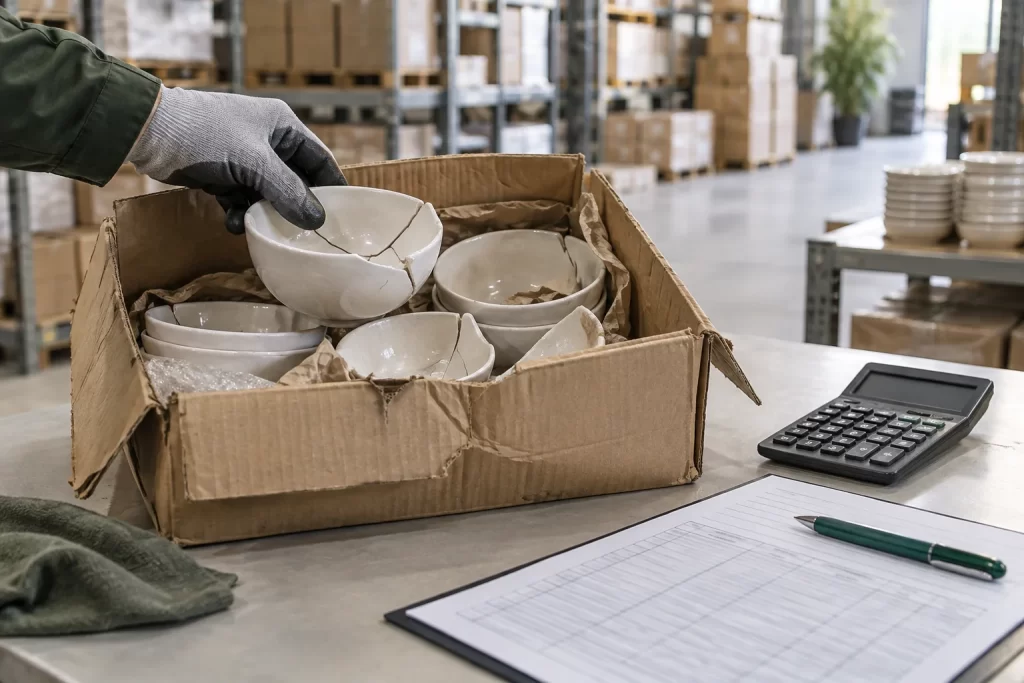
In short: As a rule, you cannot deduct VAT on lost goods (zayi mal). If you already deducted it, you add it back on the VAT return for the period the loss occurred. However, earthquake, flood, and fire in locations where the Ministry has declared force majeure are exceptions. Even so, for a depreciable fixed asset, you correct only the portion tied to the unused period.
A batch rotting in a warehouse, a pallet stolen, a shelf flooded. They all raise the same question: what happens to the VAT you paid when you purchased the goods? So there is no one-line answer. Instead, the type of goods, the cause of the loss, and your documentation all change the outcome. This guide therefore reduces the decision to five questions.
What does “lost goods” mean?
VAT Law No. 3065 does not define “lost” (zayi olma). Instead, practice follows the ordinary meaning of the word. For example, lost goods are goods that permanently leave the business’s assets: fire destroys them, they rot, thieves steal them, or floodwater sweeps them away. So this is the core case covered by lost-goods rules.
The key test is whether the goods still physically exist. If the goods are still there but their value has dropped, the situation counts as impairment rather than as lost goods, and you keep the input VAT deduction. For the distinction between the two, see our article on lost goods versus impaired goods.
What does the law say about VAT on lost goods?
The rule sits in Article 30/c of VAT Law No. 3065. It states that you cannot deduct VAT related to lost goods. However, the rule carves out three situations:
- goods lost as a result of an earthquake,
- goods lost as a result of a flood,
- goods lost as a result of fire in locations where the Ministry has declared force majeure due to fire.
The exceptions stop there. Theft, an ordinary workplace fire, a traffic accident, or spoilage are not on it. So in those cases, you correct the VAT deduction. Fire cases also require extra care: if the Ministry has not declared force majeure for that location, the exception does not apply. Our article on VAT on goods lost in earthquake, flood, and fire covers the disaster cases in more detail.
How is the VAT corrected?
You make the correction in the period the loss occurred. You then add the previously deducted VAT back on that period’s VAT Return No. 1. From the March 2026 tax period onward, you enter it in the Other Transactions table of the Tax Base section under code 507, “VAT Previously Deducted on Lost Goods.” Under the earlier return layout, this was the line named “VAT to Be Added Back.” This reverses the deduction. So pinning down the correct date matters: a late correction can expose the business to late-payment interest and penalty risk on audit.
Which five questions should guide the decision?
The sequence below helps you place a single event in the correct regime. So answer the questions in order.
- Are the goods physically gone, or has their value simply dropped? If the goods are still there, they count as impaired, not lost. So the impairment route applies, and you keep the deduction.
- Is the loss within normal wastage? If the loss stays within the accepted wastage rate, the rule does not treat it as lost goods. For the portion exceeding the rate, see our article on VAT when the normal wastage rate is exceeded.
- Is the event one of the three exceptions? If it is an earthquake, a flood, or a declared fire, you need no correction. Otherwise, you must correct the VAT.
- Are the goods trade goods or a depreciable fixed asset? For trade goods, you correct the entire VAT amount. For a depreciable fixed asset, the calculation is proportional instead; see the details below.
- Were the goods destroyed? For goods destroyed because they reached the end of their shelf life, the tax office and the Council of State take different views. So our article on VAT on destroyed goods explains this split.
Why are trade goods and depreciable fixed assets calculated separately?
You hold trade goods to sell them. If you lose them, no one ever sells them, so you correct the entire VAT amount. A depreciable fixed asset, by contrast, serves the business for years — machinery, vehicles, and plant fall into this group. Tax rules label this group a depreciable fixed asset.
Law No. 7104 introduced a special rule for depreciable fixed assets, effective 1 January 2019, and added it into Article 30/c. Under this rule, if a depreciable fixed asset completes its useful life before you lose it, you can deduct its VAT in full. If you lose it before it completes its useful life, however, you can deduct the portion of VAT tied to the period already used, and you must correct the remaining portion — the one tied to the unused period. The relevant tax procedure lists set out useful lives under Article 315 of the Tax Procedure Law (VUK).
Example: two different losses, two different outcomes
For example, a business suffers two losses in the same year. The first is trade goods stolen from its warehouse. The second is a machine with a 5-year useful life that had already been in use for 3 years. The machine became unusable in an ordinary fire, and the Ministry had not declared force majeure for it. The figures are illustrative only.
| Item | Trade goods (theft) | Machine (ordinary fire) |
|---|---|---|
| Input VAT at purchase | TRY 80,000 | TRY 200,000 |
| Deduction preserved | TRY 0 | TRY 120,000 (3/5 used) |
| VAT to Be Added Back | TRY 80,000 | TRY 80,000 (2/5 unused) |
As you can see, the same correction amount can arise from very different starting figures. Treating a depreciable fixed asset like trade goods is therefore an expensive mistake.
Which documents should be in the file?
Only the right documentation can defend a correct decision. Depending on the type of event, the file should therefore include:
- the type, quantity, batch number, and cost value of the lost goods,
- a valuation commission decision or an independent expert report,
- if destruction takes place, an official destruction report,
- in theft or accident cases, a police report and a prosecutor’s office application,
- in disaster cases, the official source of the force majeure declaration,
- for a depreciable fixed asset, the date you capitalized it, its useful life, and the calculation of the period used.
Separately, how the reporting and record-keeping should flow inside the organization is its own topic, covered under Article 30/c of VAT Law No. 3065.
What happens to the cost of lost goods?
The VAT correction is only half the story; the other half is income and corporate tax. Can you expense the cost of the goods? Can you add the corrected VAT to the cost? The answer depends on the cause of the loss. We covered these questions in our article on whether the cost of lost goods can be expensed.
Frequently asked questions
Can you deduct VAT on lost goods?
As a rule, no. Under Article 30/c of VAT Law No. 3065, you cannot deduct VAT on lost goods. However, earthquake, flood, and fire in locations where the Ministry has declared force majeure are exceptions.
In which period do you correct VAT on lost goods?
In the period the loss occurred. You enter previously deducted VAT on the VAT to Be Added Back line of that period's VAT Return No. 1.
If you lose a depreciable fixed asset, do you correct all of its VAT?
No. If the asset has completed its useful life, you can deduct its VAT in full. If you lose it before it completes its useful life, however, you can deduct the portion tied to the period used, and you must correct the portion tied to the unused period.
Is theft treated as lost goods?
Yes. Theft is not among the exceptions listed in the law, so you correct VAT on stolen goods in the period the event occurred.
Sources
- VAT Law No. 3065, Article 30/c
- Tax Procedure Law No. 213 (VUK), Article 315
- Law No. 7104, Article 9 (Official Gazette, 6 April 2018, No. 30383)
- VAT General Implementation Communiqué, Section III/C-2.4
- Ahmet Serdar Uysal, Certified Public Accountant (YMM), information note on lost goods under Article 30/c of the VAT Law (2026). We drew on this note in preparing this article; interpretations and any errors are Scrap’s own.
This article reflects the legislation in force on its publication date. It is for general information only and does not replace tax advice. Consult your financial advisor before acting on a specific case. To set up your destruction and lost-goods process together with us, you can fill out our request form.
İmha Sürecinizi Planlayalım
Vergi avantajı takvimi ve imha süreciniz hakkında ücretsiz danışmanlık alın.