


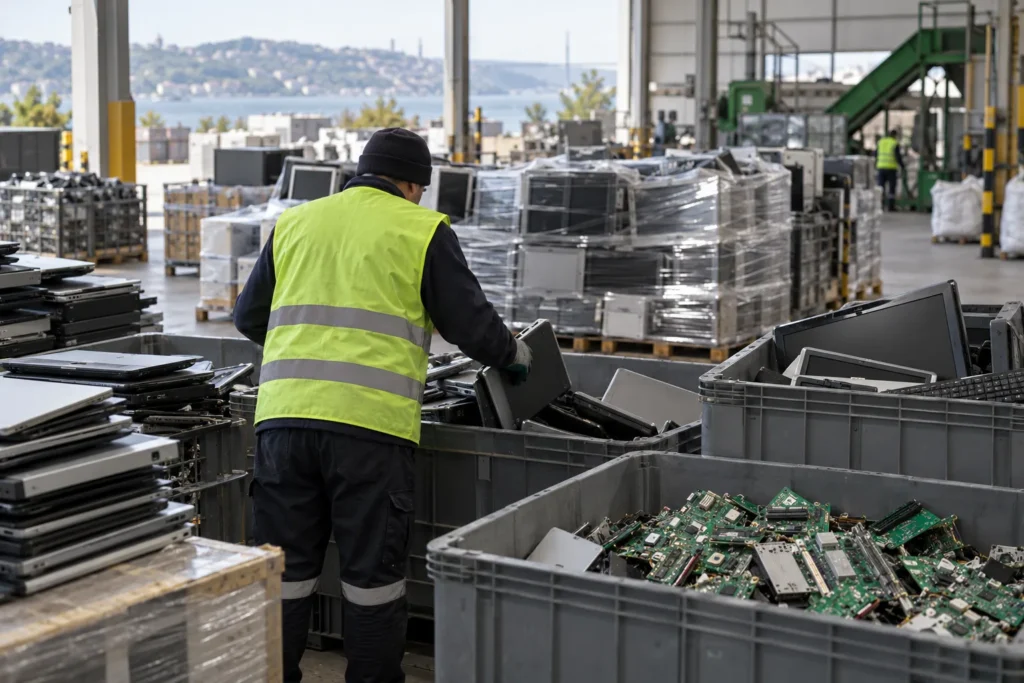
In short: Electronic waste disposal and recycling starts with a device list and ends with destruction minutes from a licensed facility. As the consultant, Scrap prepares the quote, arranges the facility and vehicle, watches the work on site and hands over the documents.
Old laptops, monitors, and boxes of circuit boards pile up in a storeroom. Nobody knows where they should go, but everyone wants a document in the file. This article walks through electronic waste disposal and recycling step by step. If you want the definition of e-waste, read our e-waste guide. Here you will read how electronic waste disposal and recycling runs, not what the term means.
What are the steps of electronic waste disposal and recycling?
Electronic waste disposal and recycling follows six steps: inventory and quote, data preparation, official inspection where required, transport, processing and file handover. Each step has a clear owner. The table shows the flow Scrap applies.
| Step | What happens | Who does it |
|---|---|---|
| 1. Inventory and quote | You send the device list with types, quantities, and any available serial numbers. We prepare the quote. | You and Scrap |
| 2. Data preparation | You back up the data, close the accounts, and mark the data-bearing parts on the list. | You |
| 3. Official determination | On the standard tax route, the valuation commission inspects the devices. Notary minutes and expert reports support the file where needed. We file the application. | Official body; Scrap files |
| 4. Transport | The devices go to the facility in a licensed or unlicensed vehicle, depending on the waste type. We arrange the vehicle. | Carrier; Scrap arranges |
| 5. Disposal and recycling | The facility processes the devices, physically destroys the data-bearing parts, and issues the minutes. | Licensed facility; the Scrap team watches on site |
| 6. File | We hand over the minutes, the list, and the photo and video record in one file. | Scrap |
Step three is not needed in every job. It applies only if the device lost value and you want to expense the stock. In that case we run the applications and appointments. The valuation commission is the body that inspects goods and determines their arm’s-length value for tax purposes. When the official bodies count and inspect the goods, the Scrap team accompanies them and records the work in photos and video. We also plan with you the step of handing the minutes to the tax office.
How do you prepare the list for electronic waste disposal and recycling?
List the device types, quantities and any serial numbers. This list is the starting point for the quote. The clearer the list, the faster the quote arrives and the easier the minutes match it. For example, these columns are enough:
- Type and quantity: monitor, laptop, printer, server, phone, handheld terminal.
- Brand, model, and serial number: to match your fixed-asset register.
- Location: warehouse, office, or branch.
- Condition: working, faulty, or broken.
- Battery inside: battery devices follow a separate route. See our lithium battery guide.
If the devices sit in two warehouses, say so on the list, because the transport plan changes. Also, on loading day we photograph the pallets and cartons. At year end, this record answers the question “which device went where”.
What happens to data-bearing parts?
The facility physically destroys data-bearing parts. Hard drives, solid-state drives, memory cards, and phone storage belong to this group. Deleting files or resetting to factory settings does not by itself guarantee that the data cannot be recovered. In electronic waste disposal and recycling, physical destruction aims to eliminate that risk. The quote specifies the method. First, before handover, we ask you for three things:
- Back up the data you need and check that the backup opens.
- Sign out of accounts and release company licenses on the devices.
- Mark the data-bearing parts separately in the inventory.
The standard facility minutes group drives and memory cards under the general waste description. Separate entries are exceptional. If you need a specific data destruction standard or a separate certificate, ask for it in writing at the quote stage. You should know what the minutes cover before the devices leave.
Where can a company hand over old electronics?
A company can hand over old electronics in four places. These are the municipal collection system, a waste drop-off center, the seller’s or producer’s collection point, or a waste electrical and electronic equipment (WEEE) treatment facility. The WEEE Regulation lists them in Article 11. The same article bars you from giving WEEE to unregistered collectors.
The regulation counts a company that uses a device as a “consumer”. Your company is therefore responsible for keeping e-waste separate.
A scrap dealer at your door takes the device on the spot and even pays for it. But you cannot document what happens next. The Regulation on Waste Management requires a licensed facility for recovery and disposal. Transport requirements depend on the waste type. That is why we work only with facilities that hold an environmental permit and license.
If you buy a new device, there is a second route. You can ask the seller to take back an old device of the same type. The regulation tells the seller to do this regardless of brand or model.
Which vehicle carries electronic waste, and which record is kept?
In electronic waste disposal and recycling, the waste type determines the vehicle licence and whether a MoTAT (Mobile Waste Tracking System) record is required. Hazardous waste and waste listed in Annex 1 to the Transport Communiqué require a licensed vehicle. An unlicensed vehicle can carry non-hazardous waste outside that scope. The waste code shows which one you need. The waste owner or an environmental engineer sets the waste code.
The transport of hazardous waste is recorded in MoTAT, the Mobile Waste Tracking System. The waste owner is responsible for the record, and Scrap enters the shipment on the customer’s behalf. The carrier and the facility confirm their own steps. We also arrange the vehicle. Where no MoTAT record is needed, we still put the handover note and the dispatch notes in your file. Scrap sends the customer the product and disposal facility details. The customer issues the dispatch note, and Scrap follows up until it is ready.
We secure the pallets with Scrap security tape and seal the loaded vehicle with a serial-numbered Scrap seal. The carrier takes it to the facility sealed. At the facility, Scrap opens the seal, watches and records unloading and processing in photos and video, then collects the facility’s minutes.
Temporary storage has a limit too. As a general rule, the regulation lets you hold hazardous waste for at most 6 months and non-hazardous waste for at most 1 year. So do not keep waste longer than that.
What should the destruction minutes say?
The destruction minutes for electronic waste disposal and recycling show the date, waste, shipment and physical destruction statement. The facility issues them, we hand them to you, and you keep them. We look for these lines before we accept the minutes:
- Date of processing.
- Waste code and general waste description.
- Quantity in kilograms.
- Dispatch note number.
- Statement that the products were physically destroyed so they cannot be reused.
Then we compare the weight and waybill number on the minutes with the dispatch documents. Matching quantities is one part of the file check. The file also contains the minutes, processing records and any required official documents. If there is a difference, we settle it with the facility before handover.
How long do you keep e-waste records?
You keep electronic waste disposal and recycling records for at least five years. The Regulation on Waste Management gives the waste producer two duties: keep chronological records and file the annual waste declaration. You file the declaration every year by the end of March through the Ministry’s Waste Declaration System (TABS). If you wish, we file last year’s waste declaration on your behalf. However, check with your environmental engineer whether your company falls within this scope.
Breaches trigger the sanctions of the Environmental Law No. 2872. The amounts change every year, so we do not list them here.
Is there a tax side to electronic waste disposal and recycling?
Yes. If devices have lost value, the standard tax route relies on the valuation commission’s inspection and its decision after destruction. Article 278 of the Tax Procedure Law values goods at arm’s-length value when they lose much of their value through spoilage, breakage, or rust. The valuation commission decides whether pure technological aging falls within it. On VAT, the tax office and the Council of State differ. We cover that in VAT on destroyed goods. For unsold products, see our article on unsold electronics disposal.
Where do you follow the process?
You follow electronic waste disposal and recycling in the Online Tracking System. There you see which step is complete and who did what in that step. Also, the minutes, handover papers, and reports are archived in the same place, and you can download them at any time.
Under Service Providers, the Online Tracking System shows current facility and carrier permits and licences, the facility’s quality certificate and MoTAT (Mobile Waste Tracking System) number, and vehicle and driver records. At the end of every destruction and recycling process, Scrap gives the customer a Sustainable Transformation Report describing the outcome.
What does Scrap do in this process?
Scrap gives destruction and recycling consultancy and does not run a facility. First, we take your device list and prepare the quote. Then we choose the licensed electronic waste recovery facility and the vehicle that suit your devices. On processing day the Scrap team is at the facility and records the work with photo and video. We collect the minutes the facility issues, compare them with the dispatch documents, and hand them to you. If you need the tax side, we also run the determination applications. That way electronic waste disposal and recycling closes in one file.
If your list is ready, fill out the request form and we will build the quote together.
Frequently asked questions
Where do you throw electronic trash?
Electronic trash does not go in the bin. You hand it to the municipal collection point, a waste drop-off center, the seller's or producer's collection point, or a WEEE treatment facility. The WEEE Regulation says the same for companies and bans giving WEEE to unregistered collectors.
What are three examples of electronic waste?
Monitors, printers, and mobile phones come first. Laptops, servers, lamps, and small household appliances fall in the same group. Flag battery-containing devices in the list for your quote. Batteries are handled in a separate waste stream.
Is a company a consumer under the WEEE Regulation?
Yes. The regulation defines a consumer as a natural or legal person who uses electrical and electronic equipment. Any company that uses devices keeps e-waste separate, hands it to a proper collection system, and avoids unregistered collectors.
Does a factory reset erase the data completely?
A factory reset alone may leave data recoverable. Physical destruction aims to eliminate that risk, and the quote sets out the method. Standard facility minutes group drives and memory cards under a general description. If you need a separate record, flag it at the quote stage.
Who issues the electronic destruction minutes?
The facility that processes the devices issues the minutes. Scrap collects them from the facility, compares them with the dispatch documents, and hands them to you. You can also download the document from the Online Tracking System.
Can I give the old device to the seller when I buy a new one?
Yes. You can ask the seller to take back an old device of the same type. The regulation tells the seller to do this regardless of brand or model.
Sources
- Regulation on the Management of Waste Electrical and Electronic Equipment (Official Gazette, 26 December 2022, No. 32055), Articles 4, 5, 10, 11, and 13
- Regulation on Waste Management (Official Gazette, 2 April 2015, No. 29314), Articles 5, 9, 10, 12, 13, 15, and 25
- Communiqué on the Carriage of Waste by Road (Official Gazette, 20 March 2015, No. 29301), Articles 2, 5, and 12
- Tax Procedure Law No. 213, Article 278
This article is general information and does not replace legal, environmental, or tax advice. Consult your environmental engineer and your financial advisor before a specific disposal.
İmha Sürecinizi Planlayalım
Vergi avantajı takvimi ve imha süreciniz hakkında ücretsiz danışmanlık alın.