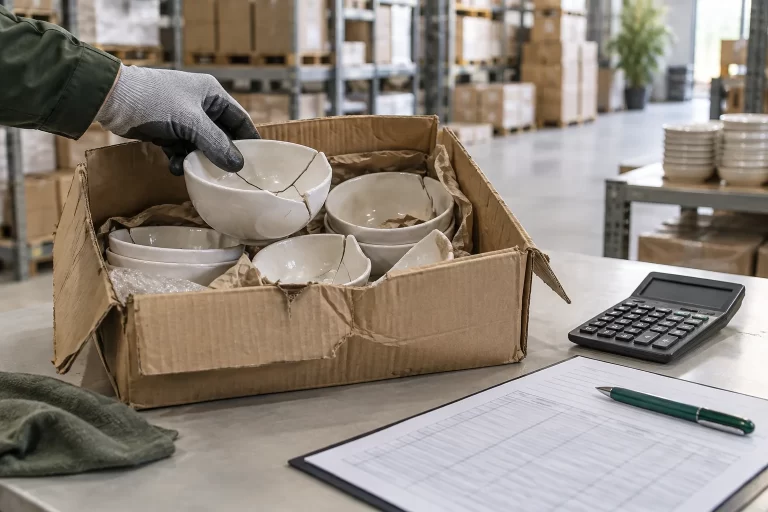



In short: You can expense the cost of lost goods from a documented fire, flood, or spoilage. What’s more, the VAT you correct can also be an expense or cost element. But views diverge on theft. Insurance indemnity affects only your profit-and-loss calculation, not the VAT.
After a loss event, the first question is usually VAT. But there is a second question too: what happens to the cost of lost goods? This question directly affects income and corporate tax. And the answer depends on the cause of the loss. This article explains those differences.
Does the VAT you correct become an expense?
Article 58 of VAT Law No. 3065 states: “VAT calculated on the taxpayer’s taxable transactions and VAT that the taxpayer could deduct are not accepted as an expense in determining the income and corporate tax base.”
The article only bans VAT you could deduct. So VAT for which you lost the deduction right under Article 30/c falls outside this ban. The tax administration’s approach points the same way: VAT you correct on lost goods can be an expense or cost element for income or corporate tax. Otherwise, the same amount would be taxed twice.
When do you expense the cost of lost goods?
If the loss arose from an ordinary risk of business activity and you can document it, you expense the cost of lost goods. An ordinary fire, flood, or spoilage falls into this group, for example. In accounting, you usually record this amount under account 689 Other Extraordinary Expenses and Losses. You can group the corrected VAT under the same account as the cost of lost goods.
The key word here is documentation. Without a valuation commission decision, an expert report, or a destruction report, this expense stays weak. This is, in fact, the first item auditors question. The same document also sets the period: under Tax Procedure Law General Communiqué No. 496, you expense the cost of destroyed goods in the period in which the valuation commission decision or the destruction report is notified to you. The VAT correction, however, belongs to the period covering the destruction date, so the two entries do not always fall in the same period. Because you cannot deduct the corrected VAT, you can expense it together with the cost, that is, on the VAT-inclusive amount.
Why is theft treated differently?
On the VAT side, theft is clear: it is not among the exceptions in the law, so you correct the VAT. On the cost side, however, views diverge. Some experts treat the cost of stolen goods and its VAT as a non-deductible expense (KKEG). Others treat a documented theft as an ordinary business risk.
The common thread is proof. If you cannot document the theft with a police report and a prosecutor’s office application, the tax administration may question the loss itself. So if the theft amount is significant, requesting an advance tax ruling (özelge) before expensing the cost of lost goods is the safest path.
How does insurance indemnity enter the calculation?
An indemnity is not consideration for a supply of goods or services. So it falls outside the scope of VAT and does not change your VAT correction. For income and corporate tax, however, two separate rules apply:
- Fixed assets (VUK 329): you compare the indemnity to the asset’s net book value, that is, cost less accumulated depreciation. If the indemnity is higher, the difference is profit; if lower, it is a loss. In addition, since 2021 Law No. 7338 offers an option: if you have decided to replace the asset, you can hold the excess indemnity in a temporary liability account for up to three years.
- Trade goods (VUK 330): if the indemnity exceeds the value of the goods, you record the excess as profit.
Example: an insured machine burns down
A manufacturing company’s machine becomes unusable in a fire for which no force majeure was declared. The machine’s cost is TRY 800,000 and its accumulated depreciation is TRY 500,000. The insurance company pays the company TRY 360,000 in indemnity. The figures are illustrative only.
| Item | Amount | Note |
|---|---|---|
| Net book value (800,000 − 500,000) | TRY 300,000 | Recorded value on the date of the fire |
| Indemnity received | TRY 360,000 | Insurance payment |
| Difference recorded as profit | TRY 60,000 | VUK 329 |
You calculate the VAT side independently of this table. That is, you correct the VAT tied to the machine’s unused period whether or not there is an indemnity. We gave an example of this calculation in our article on goods lost in earthquake, flood and fire.
Summary table by cause of loss
| Cause of loss | VAT | Cost of lost goods |
|---|---|---|
| Documented fire, flood, spoilage | You correct it; the corrected amount can be an expense/cost | You expense it |
| Earthquake, flood, declared fire (trade goods) | No correction | You expense it |
| Theft | You correct it | Contested; advance ruling recommended |
| Loss within normal wastage | No correction | Included in product cost |
| Loss exceeding normal wastage | You correct the excess portion | Depends on documentation |
We covered the wastage side in detail in our article on the normal wastage rate, and the disaster cases in our article on earthquake, flood, and fire.
Frequently asked questions
Can I expense the VAT I correct?
Yes, generally. Article 58 of VAT Law No. 3065 only bans VAT you could deduct as an expense. VAT for which you lost the deduction right under Article 30/c can be an expense or cost element.
Can I expense the cost of stolen goods?
Views diverge. Some experts treat it as a non-deductible expense. If the amount is large, request an advance tax ruling and document the theft with a police report.
Does insurance indemnity change the VAT correction?
No. The indemnity falls outside the scope of VAT. It only creates a profit or loss for income and corporate tax under VUK 329 and 330.
Sources
- VAT Law No. 3065, Articles 30/c and 58
- Tax Procedure Law No. 213 (VUK), Articles 329 and 330
- Law No. 7338 (Official Gazette, 26 October 2021, No. 31640)
This article reflects the legislation in force on its publication date. It is for general information only and does not replace tax advice. Consult your financial advisor before acting on a specific case. To run your lost-goods and destruction process on a documented basis, you can fill out our request form.
İmha Sürecinizi Planlayalım
Vergi avantajı takvimi ve imha süreciniz hakkında ücretsiz danışmanlık alın.