


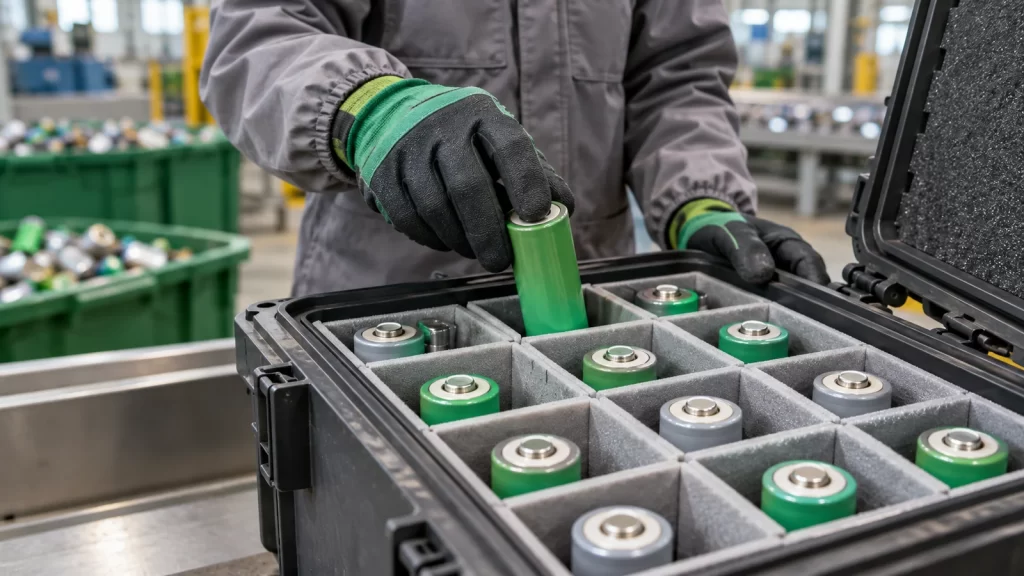
In short: A lithium battery can ignite by itself when damaged or stored wrongly. Therefore, you cannot throw a waste lithium battery in the trash, store it with other waste, or burn it; the legislation bans this explicitly. The right way has three steps: you collect the battery separately, have it transported under the rules, and deliver it to a licensed facility.
One box of returned power banks in the warehouse looks harmless. Yet if one of them has swollen, that box is the riskiest load on the shelf. That is because a lithium battery behaves differently from other waste. Moreover, almost every device today has one inside. This article explains the risk, the rules, and the right process in order.
Why does a lithium battery carry a separate risk?
A lithium battery stores a lot of energy in a small volume. If you crush it, puncture it, or overheat it, a short circuit can form inside. Then the temperature rises fast and the reaction feeds itself. Engineers call this chain thermal runaway. As a result, the battery gives off smoke, catches fire, and can ignite the batteries next to it.
This fire is hard to put out, too. That is because the battery can reignite even after you put out the flames. Therefore, the real precaution starts before a fire breaks out. In particular, separate a swollen, crushed, or heating battery from the others right away.
Which products contain a lithium battery?
The list grows every year. For example, almost all of the following products run on a lithium battery:
- phones, tablets, and laptops,
- power banks, wireless headphones, and smartwatches,
- cordless vacuum cleaners and cordless power tools,
- electric scooters and electric bikes,
- handheld terminals and portable measuring devices.
Therefore, every company that disposes of electronic stock also manages batteries. For the process for unsold devices, see our article on electronics disposal.
What does the legislation say about a waste lithium battery?
The core text is the Regulation on the Control of Waste Batteries and Accumulators, which appeared in Official Gazette No. 25569 dated August 31, 2004. The regulation sets three rules clearly:
- You collect waste batteries separately from household waste.
- You deliver waste batteries to collection points that sellers or municipalities set up.
- You cannot store waste batteries with household and other waste, leave them in nature, or burn them.
Industrial facilities face one more rule. A waste accumulator from forklifts, power supplies, and similar equipment can wait at the factory site for at most ninety days. In addition, the floor must be leak-proof.
What if the battery is inside the device? In that case, the Regulation on the Management of Waste Electrical and Electronic Equipment (WEEE, AEEE in Turkish) applies first. The facility removes the battery from the device and then manages it under the battery regulation. You can find the device-side rules in our e-waste guide.
How should a waste lithium battery wait in the warehouse?
The legislation draws the general frame; good practice sets the detail. The list below gathers measures your warehouse team can apply on day one:
- Keep batteries in a cool, dry area away from other waste and flammable material.
- Tape exposed terminals so batteries do not touch each other and short-circuit.
- Separate swollen or damaged batteries from sound ones and keep them in a nonflammable container.
- Do not stack boxes on top of each other, because the battery at the bottom can crush under the weight.
- Do not store batteries for a long time; deliver them at regular intervals.
How does a lithium battery travel?
On the road, a lithium battery counts as a dangerous good. The ADR agreement, which governs the transport of dangerous goods by road, places lithium batteries in Class 9. For example, a lithium-ion battery alone takes UN 3480, and one inside a device takes UN 3481. This number sets the packaging, the label, and the transport document.
In short, do not load a waste battery on a random vehicle. Instead, leave transport to a company that works with an ADR-compliant vehicle and a trained driver. In addition, keep the delivery document in your file.
What steps does a lithium battery go through at the facility?
First, a licensed facility discharges the battery’s remaining energy. Then it dismantles and shreds the battery. At the end of this step, a dark powder called black mass comes out. This powder holds metals such as lithium, cobalt, and nickel. Finally, a recovery facility separates these metals and supplies them as raw material for new battery production.
In short, in a process you set up correctly, the battery does not go to the trash. In an unregistered stream, on the other hand, this value disappears and the fire risk moves to someone else’s warehouse.
What awaits companies that sell to Europe?
The European Union renewed its battery rules. The Batteries Regulation (EU) 2023/1542 has applied since February 18, 2024. The regulation spreads obligations over several years. For example, starting February 18, 2027, electric vehicle batteries, light means of transport (LMT) batteries, and industrial batteries with a capacity above 2 kilowatt-hours will carry a digital battery passport. Therefore, companies that sell battery-powered products to Europe should record the battery’s source and end of life now.
Frequently asked questions
Can I throw a waste lithium battery in the trash?
No. The Regulation on the Control of Waste Batteries and Accumulators requires you to collect waste batteries separately from household waste. In addition, it bans storing them with other waste and burning them.
What should I do with a swollen battery?
Separate it from the other batteries right away and keep it in a fireproof container. Do not puncture, crush, or charge it. Then deliver it to a licensed facility as soon as possible.
Which dangerous goods class covers a lithium battery?
Class 9 under ADR. For example, a lithium-ion battery on its own is UN 3480, and one inside a device is UN 3481.
Which rule applies to the battery inside a device?
The WEEE Regulation applies first. The facility removes the battery from the device. Then it manages the battery under the Regulation on the Control of Waste Batteries and Accumulators.
Sources
- Regulation on the Control of Waste Batteries and Accumulators (Official Gazette, August 31, 2004, No. 25569), general principles and Article 13
- Regulation on the Management of Waste Electrical and Electronic Equipment (Official Gazette, December 26, 2022, No. 32055), Article 5
- Batteries Regulation (EU) 2023/1542
- European Agreement concerning the International Carriage of Dangerous Goods by Road (ADR), Class 9
This article follows the legislation in force on its publication date. It is for general information and does not replace the assessment of your occupational safety and fire expert. If you want to plan the process for your battery-powered products together with us, you can fill in our request form.
İmha Sürecinizi Planlayalım
Vergi avantajı takvimi ve imha süreciniz hakkında ücretsiz danışmanlık alın.