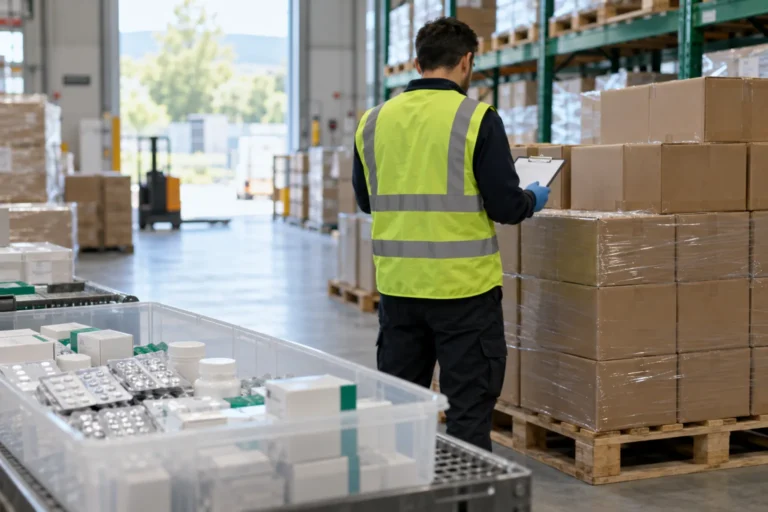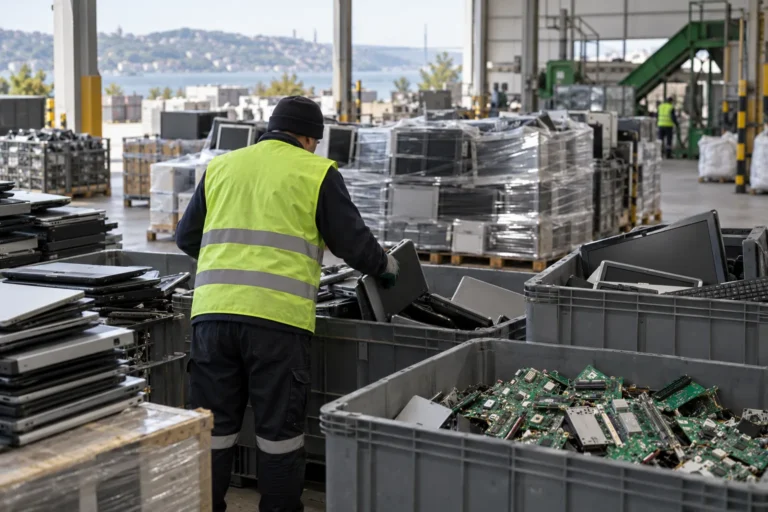



In short: To choose a licensed disposal company, check its permit, scope, transport, delivery record, minutes, on-site evidence, tax support and written quote. Across its fields of activity, Scrap provides destruction and recycling consultancy and coordinates the facility, transport, on-site records and documentation.
Disposal ends the product’s story, but not your responsibility. If a product stays in an uncontrolled place, it can leak into the gray market and hurt your brand. If you cannot document the disposal, you cannot explain the written-off stock to the tax office. So choosing a licensed disposal company is a risk decision, not a purchasing decision. This article shows which documents, questions, and warning signs matter. You can read how the leakage risk starts in our article on uncontrolled disposal.
What does a licensed disposal company mean?
A licensed disposal company processes waste at a facility that holds an environmental permit and licence. The Regulation on Waste Management requires a licensed facility for recovery and disposal. Transport requirements depend on the waste type. Hazardous waste and waste listed in Annex 1 to the Transport Communiqué require a licensed vehicle. An unlicensed vehicle can carry non-hazardous waste outside that scope. So a middleman who simply “takes it away cheaply” is not a licensed disposal company without the documents.
Here is a clear distinction, because the roles differ. Scrap is a destruction and recycling consultancy, and we have no facility of our own. The licensed facility does the destruction and recycling. We manage the process on your behalf: we collect the facility’s permit, file the official applications, arrange transport, watch the work on site, and hand you the minutes. You deal with one team.
Which 8 checks should you run when choosing a licensed disposal company?
When choosing a licensed disposal company, check its licence, scope, transport, handover record, minutes, on-site evidence, tax support and written quote. Use the same order to compare quotes. The table lists each check, the question for the firm, and how Scrap answers it.
| Check | What do you ask the firm? | How Scrap handles it |
|---|---|---|
| 1. Environmental permit and licence | Does the facility that will do the work hold a current document? | Current facility and carrier records appear under Service Providers in the Online Tracking System |
| 2. Scope of the document | Does the facility accept your product type and waste code? | We match your product list to the facility’s accepted scope |
| 3. Transport | Does your waste need a licensed vehicle, and who provides it? | We arrange a licensed or unlicensed vehicle, depending on the waste type |
| 4. Delivery record | Does the facility inspect and weigh the waste on arrival and issue a document? | We put the delivery and weighing documents in your file |
| 5. Destruction minutes | Who issues them, and what do they list? | The facility issues them; we check them and hand them to you |
| 6. Evidence record | Are there photos or video, and who watches the destruction? | Scrap tapes the pallets and seals the vehicle after loading with a serial-numbered seal. At the facility the team opens the seal, watches and records unloading and processing. |
| 7. Tax support | Who runs the notary, expert, and valuation commission steps? | We file the applications, book the determination appointments, and run the tax office steps |
| 8. Written quote | Which items are included, and which are separate? | We list consultancy, disposal, transport, notary, and expert items separately as applicable |
The valuation commission is the body that inspects goods and determines their arm’s-length value for tax purposes. The first three checks screen firms out, so do not continue with a firm whose document, scope, or transport plan is unclear. The other five checks separate good work from average work. For example, two firms may both show a permit, but only one gives photos, video, and minutes.
How do you check an environmental licence?
Ask the licensed disposal company for a current copy and its annexes, read the scope, and ask the issuing authority if in doubt.
- First, check who owns the document: do the facility’s name and address match the place where your products will go?
- Then read the validity date and the activity type: collection, transport, recovery, or disposal.
- Next, check that your product group and waste code appear in the document; if it is unclear, ask the facility.
- Finally, if doubt remains, ask the issuing authority, meaning the Ministry or the provincial directorate.
You can follow the same four steps for any licensed disposal company. The Ministry’s General Directorate of Environmental Management publishes some lists under “Yetkilendirmeler ve Lisanslar” (Authorizations and Licences).
What is the difference between a consultancy and a disposal facility?
The facility processes the waste; the consultancy sets up, follows, and documents the process. Both are legitimate, but the quote must say who takes on what. You can go to a facility directly. Then the official applications, determination appointments, transport plan, minutes check, and tax office steps stay with you. If you work with a consultancy, we run these tasks. Companies with several sectors, frequent disposals, or a sensitive tax file usually choose this route.
The work also changes by sector. In pharmaceutical disposal, the district health directorate’s determination stands out. In food and beverage disposal, batch and expiry records decide the file. Cosmetics carry brand leakage risk, and electronic devices bring data-bearing parts into focus. We also have pages for medical devices, textiles, and packaging. Each product group is a separate process. The eight checks stay the same in every sector.
Which items appear in a licensed disposal company quote?
Scrap’s quote lists the following items separately as applicable: consultancy, disposal, transport, notary, and expert. In Scrap’s quote, the consultancy fee covers the consultancy service, the officials’ travel costs, and the photo and video recording. The other items that apply are separate, and their invoices are issued in your company’s name.
The disposal fee appears in the quote with an estimated tonnage and is finalized by the facility’s weighing. The notary fee changes with the page count of the attachments and the number of days the work takes. So ask early about the things that enlarge the job: products in two separate warehouses, different product groups on one list, and a list that changes after the application. Authorities are busy at year end, so November and December jobs take longer.
Which warning signs should you watch for in a quote?
A firm that will not show its documents at the quote stage is the first warning sign. “The document will come later” is the same sign. Stop and ask questions if you see any of these:
- The quote is given only by phone and never in writing.
- The firm will not say where it takes your products.
- It offers to take the products away, free or paid, and issues no minutes.
- The minutes do not list the products by type and quantity.
- It gives no photo, video, or delivery document.
If you see any of these signs, ask why and find out which records the quote covers. Check the licence itself to confirm its scope. The same care applies to goods held at customs, which we cover in our article on customs disposal. You can also see which duties stay with the waste owner in waste management and legal obligations.
What does the facility do when it receives waste?
The receiving facility inspects and weighs the waste on arrival and provides a document recording the result. For hazardous waste, the shipment is recorded in MoTAT (Mobile Waste Tracking System). The waste owner is responsible for the record; when you work with Scrap, we enter the shipment on your behalf. Then the carrier confirms loading, and the facility confirms receipt. The waste owner or an environmental engineer sets the waste code. We compare your product list and this code with the facility’s accepted scope. Even when no MoTAT record is needed, we still ask for the delivery and weighing documents.
We secure the pallets with Scrap security tape and seal the loaded vehicle with a serial-numbered Scrap seal. The carrier takes it to the facility sealed. At the facility, Scrap opens the seal, watches and records unloading and processing in photos and video, then collects the facility’s minutes.
Scrap sends the customer the product and disposal facility details. The customer issues the dispatch note, and Scrap follows up until it is ready.
How does the process run when you work with Scrap?
First, you send us your product list. Then we find a suitable licensed facility and arrange a vehicle. After that, we collect the documents and give you a written quote. After your approval, we file the necessary applications. For tax-supported work we book the facility after the official inspection and, where applicable, the expert report. When the official bodies count and inspect the goods, the Scrap team accompanies them and records the work in photos and video. On that day, the Scrap team watches the destruction on site and records it. We hand you the minutes, photos, and delivery documents in one file. If the tax side needs it, we also run the notary, expert, and valuation committee steps.
See the expired medicines guide for the sequence and the electronic waste disposal and recycling guide for an example of how the facility and consultant divide the work.
You follow all these steps in the Online Tracking System. It shows which step is done and who did what, and you can download the documents at any time.
The Online Tracking System’s Service Providers section shows the facility’s current environmental permit and licence, relevant waste licence, quality certificate and MoTAT (Mobile Waste Tracking System) number. It also shows the carrier’s current environmental permits and licences, relevant waste transport licence, plate number, vehicle and trailer registrations, and driver’s licence. You can also access the product list, weighbridge ticket, invoice and payment receipt, and disposal request form. At the end of every destruction and recycling process, Scrap gives the customer a Sustainable Transformation Report describing the outcome.
If your product list is ready, fill in the request form. We can prepare Scrap’s destruction and recycling quote from your list.
Frequently asked questions
How do you tell a licensed disposal company?
Ask for the current environmental permit and licence of the facility that will do the work. Check the facility name, address, validity dates and permitted activity. If in doubt, ask the issuing authority. For Scrap’s projects, the current documents appear under Service Providers in the Online Tracking System.
Which licensed firms handle recycling?
The General Directorate of Environmental Management publishes lists for certain authorisations and licences. To identify a suitable facility, check that its current licence covers your waste code and the intended process. For Scrap’s projects, the selected facility’s documents appear in the Online Tracking System.
Is a consultancy the same as a disposal facility?
No. The facility processes the waste. The consultancy sets up, follows, and documents the process. Scrap is a consultancy; we own no facility and run the destruction and recycling process with licensed facilities.
Can a disposal company transport waste without documents?
Transport records and vehicle requirements depend on the waste type. Hazardous waste and waste listed in Annex 1 of the road transport communiqué require a licensed vehicle. However, non-hazardous waste outside that scope does not need one.
Which documents should I get after disposal?
Get the destruction minutes, the delivery document, and the photo and video record and the Sustainable Transformation Report. If the tax side needs it, the valuation commission decision also joins the file, supported by the notary’s minutes and the expert report. We hand these over in one file and archive them in the Online Tracking System.
Can price alone decide the choice?
Compare price alongside the scope of services and records. If a quote is low or omits photos, ask why and confirm what documentation it includes.
Sources
- Regulation on Waste Management (Official Gazette, 2 April 2015, No. 29314), Articles 5, 9, 10, and 12
- Communiqué on the Carriage of Waste by Road (Official Gazette, 20 March 2015, No. 29301), Articles 2, 5, and 12
- Ministry of Environment, Urbanization and Climate Change, General Directorate of Environmental Management: Authorizations and Licences (viewed 27 October 2026)
- National Environmental Information System (UÇBS) login page
This article is general information and does not replace legal or environmental advice. If in doubt, confirm a document’s validity with the authority that issued it.
İmha Sürecinizi Planlayalım
Vergi avantajı takvimi ve imha süreciniz hakkında ücretsiz danışmanlık alın.