


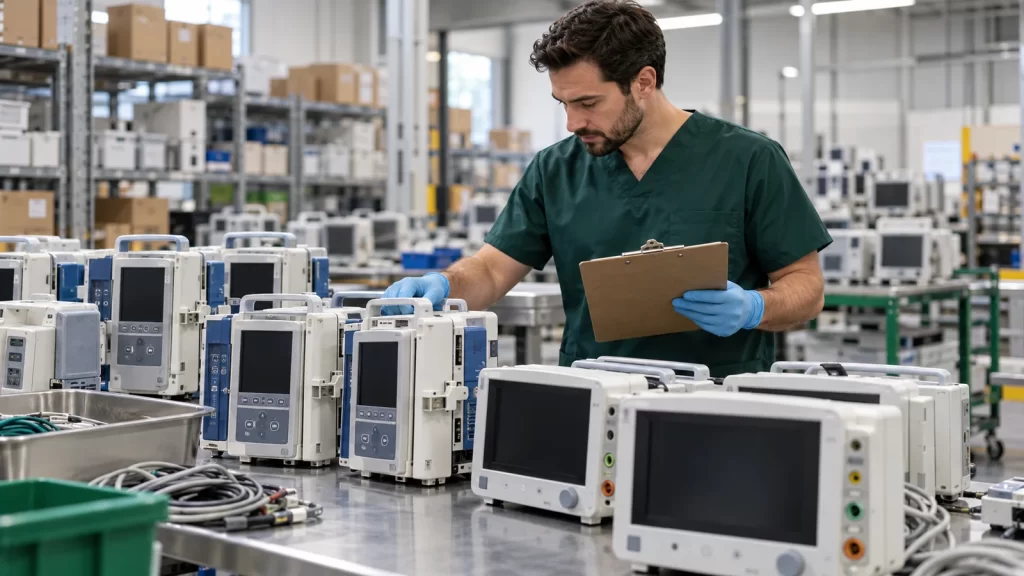
In short: A medical device recall is any measure that aims to return a device from the end user to the economic operator. A field safety corrective action (FSCA) is the corrective action that a manufacturer takes to prevent or reduce the risk of a serious incident. The Medical Device Regulation gives the manufacturer, the importer, and the distributor separate duties. However, the fate of the device in the field is a separate decision: repair, return, or documented disposal.
A software fault shows up in an infusion pump. The manufacturer issues a field safety notice. Hundreds of devices sit in hospitals, warehouses, and dealers. So in a medical device recall, who reports what, who collects what, and how do you dispose of the product in the field? This article answers these questions in order.
How do a medical device recall, a withdrawal, and an FSCA differ?
The regulation defines three terms separately (Article 3):
- Recall: Any measure that aims to return a device that is already available to the end user to the economic operator.
- Withdrawal: Any measure that aims to stop a device in the supply chain from being made available on the market.
- Field safety corrective action: A corrective action that a manufacturer takes for technical or medical reasons to prevent or reduce the risk of a serious incident with a device on the market.
In other words, a withdrawal targets the chain, while a recall targets the user in the field. An FSCA tells you why you act, not which of the two you pick. In most cases, all three run together. The manufacturer announces the action to users in a field safety notice.
Who reports an FSCA in a medical device recall, and when?
In a medical device recall, the reporting burden sits with the manufacturer. It reports every serious incident and every FSCA that involves devices on the market to the Agency and to the other competent authorities (Article 85). The deadlines depend on how severe the event is:
- General rule: The manufacturer reports immediately once it has established a causal link between the device and the incident, or once such a link is reasonably likely. This period does not exceed 15 days after the manufacturer becomes aware of the incident.
- Serious public health threat: The period is at most 2 days.
- Death or unanticipated serious deterioration in health: The period is at most 10 days.
- FSCA: Except in urgent cases, the manufacturer reports without delay before it carries out the action.
Next, the manufacturer informs users without delay through a field safety notice (Article 87). The notice appears in Turkish and/or in the official languages of the EU countries concerned, and it carries the UDI of the device. In addition, it explains the reason without understating the risk and states every action that users must take. The manufacturer also enters the notice in the system, so the public can see it.
What do the importer and the distributor do?
The regulation spreads the duties of a medical device recall across the chain. First, if the manufacturer thinks that a device does not comply, it brings the device into conformity, withdraws it, or recalls it. It also informs its distributors, its importers, and its authorized representative (Article 10).
- The importer: If it thinks that a device is non-compliant, it informs the manufacturer and the authorized representative at once. Then it cooperates with them and with the Agency on a withdrawal or recall. It also keeps a register of complaints, non-conforming devices, recalls, and withdrawals (Article 13).
- The distributor: When it reaches the same view, it informs the manufacturer and the importer at once. Moreover, it cooperates so that the withdrawal or recall proceeds properly. If the device poses a serious risk, it informs the Agency too (Article 14).
Traceability is part of this chain as well. Distributors and importers must be able to show the Agency every business that supplied the device to them directly and every health institution or health professional that they supplied directly (Article 25). This period runs for at least 10 years after the last device is placed on the market, and for 15 years for implantable devices (Articles 10 and 25).
How do you dispose of field stock after a medical device recall?
The regulation has no article that describes disposal step by step. The text touches on destruction in one place only: the Agency can seize devices that are counterfeit or pose an unacceptable risk, and it can destroy them (Article 90). So you build the disposal steps from these sources:
- The field safety notice: The notice lists the actions that users must take. There you read whether you return the device, leave it in place, or destroy it.
- Waste legislation: Once the device becomes waste, the Waste Management Regulation applies. The waste producer collects the waste separately, keeps records, and sends it to a facility that holds a permit or an environmental license (Article 9).
- Medical waste rules: The Medical Waste Control Regulation covers medical waste that arises from the activities of health institutions (Article 2). A device that touched blood or body fluid can fall into this class. A device that waits unused in a warehouse usually falls under the general waste rules.
With these sources, disposal of the field stock after a medical device recall runs in these steps:
- Read the notice: First, you match the affected model, serial, and lot numbers with the field safety notice.
- Take an inventory: Then you gather the devices in the warehouse, at dealers, and in the field in a single list.
- Set apart and mark: This way, you keep the affected devices in a marked area, away from sales stock.
- Wait for instructions: You do not dispose of any device before the manufacturer’s return or disposal instruction arrives.
- Transport under seal: You send the devices to a licensed facility with a count record, in a sealed vehicle.
- Document and report: You keep the disposal record, the delivery document, and the photos. Finally, you report the closure in writing to the manufacturer or the authorized representative.
The return of a device to the market is the biggest risk of a medical device recall. So disposal must be controlled. We explained this risk in our article on protecting brand value during disposal. For the same process on the medicine side, see our article on the medicine recall.
How do the cost and the tax of a medical device recall work?
Who pays for the medical device recall depends on the contract and on the manufacturer’s decision. Expensing the cost of the collected device and correcting the VAT are separate questions. The answer changes depending on whether the goods count as lost or as impaired. We covered this difference in our article on lost goods and impaired goods. This article does not calculate any tax result, so get your accountant’s opinion. In its medical device waste disposal service, Scrap collects, counts, destroys, and documents the product in the field.
Frequently asked questions
Is an FSCA the same as a recall?
No. An FSCA is the corrective action that a manufacturer takes to reduce the risk of a serious incident. A recall is a measure that returns the device from the end user. An FSCA can include a recall, but it can also be a software update alone (Article 3).
How many days do I have to report a serious incident?
The general rule is at most 15 days. It is at most 2 days for a serious public health threat, and at most 10 days for death or unanticipated serious deterioration in health. The period starts when the manufacturer becomes aware of the incident (Article 85).
Can I throw a recalled device in the trash?
No. First, check the instruction in the field safety notice. Once the device becomes waste, you collect it separately, keep records, and send it to a facility with a permit or an environmental license. Also document the disposal.
What should I do if I am an importer or a distributor?
If you think that a device is non-compliant, inform the manufacturer at once and cooperate on the withdrawal or recall. Also keep a register of complaints, recalls, and withdrawals (Articles 13 and 14).
Sources
- Medical Device Regulation (Official Gazette, June 2, 2021, No. 31499 bis), Articles 3, 10, 13, 14, 25, 85, 87, and 90
- Waste Management Regulation (Official Gazette, April 2, 2015, No. 29314), Article 9
- Medical Waste Control Regulation (Official Gazette, January 25, 2017, No. 29959), Article 2
This article follows the legislation in force on its publication date. It is for general information and does not replace legal or tax advice. Therefore, get the opinion of your legal counsel and your accountant before you act on a real recall decision. If you want to plan the process together with us, you can fill in our request form.
İmha Sürecinizi Planlayalım
Vergi avantajı takvimi ve imha süreciniz hakkında ücretsiz danışmanlık alın.