

In short: A medicine recall collects a product that turned out faulty or is suspected of a fault from the market. The Regulation on the Recall of Human Medicinal Products and Foods for Special Medical Purposes governs this process. The license or authorization holder returns the collected product to its source or has it destroyed in line with the legislation. Destruction follows the verification by the provincial or district health directorate. The warehouse and the distributor, in turn, stop distribution and sales once the notice goes out.
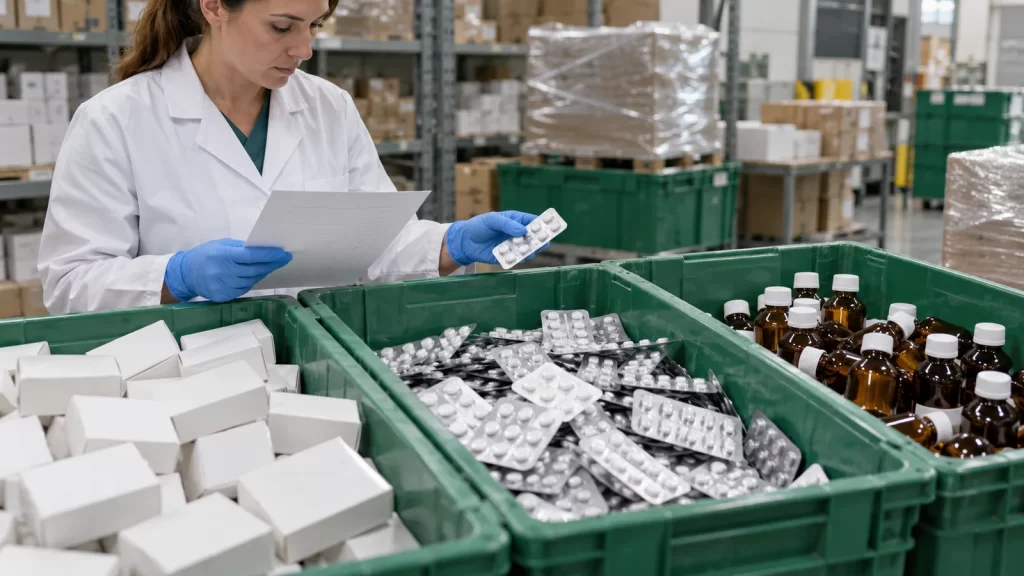
One batch of a medicine shows a quality defect. The Agency orders a recall. That same day, thousands of boxes sit in the warehouse, and more sit on shelves and in pharmacies. So who collects these boxes, how fast do they bring them under control, and how do they destroy them? This article explains the medicine recall process from the license holder’s and the warehouse’s side.
What does the medicine recall regulation cover?
The regulation sets the rules for products that turned out faulty or carry a suspected fault, from the viewpoint of consumer health and safety. Its aim is to withdraw the product from the market quickly and effectively when needed (Article 1).
It covers human medicinal products and foods for special medical purposes that hold a license or an authorization from the Agency (Article 2). In the regulation, “the Agency” means the Turkish Medicines and Medical Devices Agency (TİTCK). Moreover, this 2024 text replaced the former Recall Regulation (Article 20).
What are the classes and the deadlines in a medicine recall?
The regulation defines three classes by health risk (Article 9):
- Class I: A defect that carries a serious or life-threatening health risk.
- Class II: A defect that causes a temporary or treatable health effect.
- Class III: A defect that carries no health risk.
There are also three recall levels, A, B, and C, depending on how far the product has reached (Article 10). The class, in turn, sets how fast the license holder must act. After the notice, the license or authorization holder takes the measures needed to bring the defective product on the market under control within 24 hours in class I, 48 hours in class II, and 72 hours in class III (Article 13). The Agency also announces class I medicine recalls to the public on its website (Article 12).
What do the license holder and the warehouse do in a recall?
The regulation spreads the duties across the chain. First, the license or authorization holder leads the medicine recall (Articles 6, 12, and 15):
- Procedure and plan: It keeps a procedure and a recall plan that set out the responsibilities, the route to follow, the form of the notice, and the records to keep, so that it can recall quickly.
- Notice: Once the decision is out, it sends a written notice to every body and person that may hold the product. It also sends a copy to the Agency. The notice contains no advertising.
- Records: It keeps the distribution records and all documents on the recall for at least five more years after the product’s shelf life ends.
- Count and outcome: It has the quantity of the recalled product determined. Then it carries out the return or destruction steps.
- Loss: It makes good the harm that parties suffered because of the recalled product.
Warehouses, distributors, and pharmacies that hold the product stop distribution and sales after the notice. They take the necessary measures until the recall ends (Article 13). In addition, they draw up a feedback record in reply to the recall notice and start the return if they hold the product (Article 6).
How do you dispose of a recalled medicine?
First, the provincial or district health directorate carries out its verification. Then the license or authorization holder returns the product to its source or has it destroyed in line with the relevant legislation (Article 16). So after a medicine recall, do not destroy the product before the verification ends.
Once the product becomes waste, the Waste Management Regulation applies. The waste producer collects the waste separately, keeps records, and sends it to a facility that holds a permit or an environmental license (Article 9). Temporary storage time depends on the waste type: hazardous waste waits at most 6 months, and non-hazardous waste at most 1 year (Article 13). The waste owner sets the waste code under the code-setting rules (Article 12). So disposal after a medicine recall runs in six steps:
- Identify the batch: First, you match the batch and serial numbers in the notice with your warehouse records.
- Separate and lock: Then you set the boxes apart from sales stock, move them to an area with restricted access, and mark them.
- Count and record: You count what remains in the warehouse, at the distributor, and in returns, and compare it with the records.
- Wait for the verification: You hold the product until the health directorate completes its verification.
- Transport under seal and destroy: You send the product to a licensed facility with a count record, in a sealed vehicle. The facility makes the product unusable.
- Document and report: You keep the disposal record, the delivery document, and the photos. The license holder, in turn, gives the Agency the final report within 12 weeks at the latest (Article 17).
The Agency reviews the final report. It closes the process if the recall is complete, if the destruction follows the legislation, and if measures exist against a repeat of the defect (Article 17).
The return of the same box to the market is the biggest risk of any medicine recall. So uncontrolled disposal is dangerous. We explained this risk in our article on protecting brand value during disposal. For the harm that waste medicines do to the environment, see our pharmaceutical waste disposal service page.
Is an expired medicine the same as a recalled medicine?
No. A medicine recall is a decision about a product that turned out faulty or carries a suspected fault (Article 1). An expired medicine is not faulty. It has simply reached the end of its shelf life. When expired stock becomes waste, the Waste Management Regulation applies again. However, the medicine recall process runs if the same batch also carries a quality concern. Ask your license holder and your provincial health directorate to confirm which route applies.
What is the tax side of medicine disposal?
Article 278/A of the Tax Procedure Law covers goods that you must destroy because of the passing of an expiry date and similar reasons. For taxpayers with recurring disposals who apply, the article treats the equivalent value of the destroyed goods as zero, up to the agreed destruction rate. In addition, the taxpayer keeps every record and document on the disposal and presents them when needed.
However, it changes the result whether the goods count as lost or as impaired. We explained this difference in our article on lost goods and impaired goods. This article does not calculate any tax result, so get your accountant’s opinion before you act. In its pharmaceutical waste disposal service, Scrap carries out collection, counting, disposal, and documentation on your behalf, so your file stays complete after a medicine recall.
Frequently asked questions
When must I submit the final report?
Once the license or authorization holder is sure that the market has returned every defective product, it gives the Agency the final report within 12 weeks at the latest. You can ask for a one-time extension of 4 weeks (Article 17).
What should I do as a warehouse when I receive a recall notice?
First, stop distribution and sales. Then match the batch number with your stock and move the product to a separate area. After that, draw up a feedback record and start the return if you hold the product (Articles 6 and 13).
Can I destroy a recalled medicine myself?
First, the provincial or district health directorate carries out its verification. Then the license holder returns the product to its source or has it destroyed in line with the legislation (Article 16). Disposal on your own decision breaks this order.
Who pays for the harm of a recall?
The license or authorization holder makes good the harm that parties suffered because of the recalled product (Article 15). The tax result of the cost is a separate question, so consult your accountant.
Sources
- Regulation on the Recall of Human Medicinal Products and Foods for Special Medical Purposes (Official Gazette, October 23, 2024, No. 32701), Articles 1, 2, 6, 9, 10, 12, 13, 15, 16, 17, and 20
- Waste Management Regulation (Official Gazette, April 2, 2015, No. 29314), Articles 9, 12, and 13
- Tax Procedure Law No. 213, Article 278/A
This article follows the legislation in force on its publication date. It is for general information and does not replace legal or tax advice. Therefore, get the opinion of your legal counsel and your accountant before you act on a real recall decision. If you want to plan the process together with us, you can fill in our request form.
İmha Sürecinizi Planlayalım
Vergi avantajı takvimi ve imha süreciniz hakkında ücretsiz danışmanlık alın.