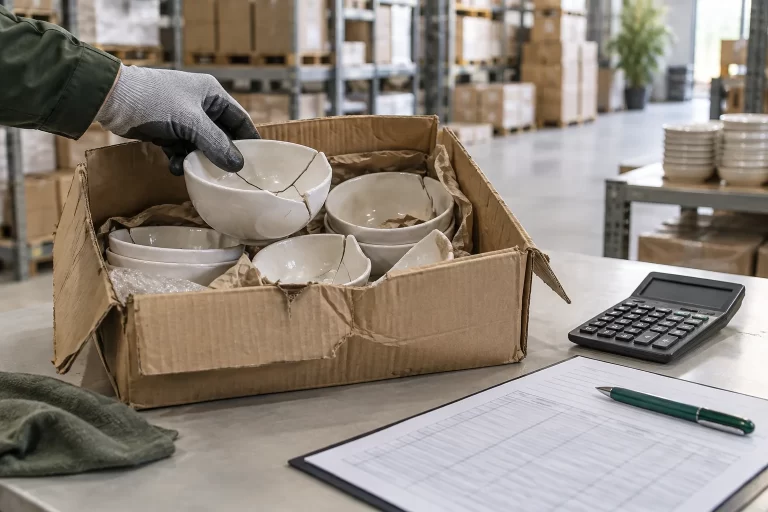



In short: You do not correct the VAT on goods lost in a flood. The VAT Law names flood as an explicit exception. But to expense the cost of those goods for corporate tax, you need a valuation commission decision. A report from AFAD or the fire brigade is not enough on its own. Insurance indemnity is a separate calculation. For stock, the part above the value of the goods is profit. For fixed assets, the difference from net book value is profit or loss.
On 14 October 2026, a flood hit Istanbul. According to the Governor’s Office, the city received its heaviest rainfall since records began in 1942. Many shops and warehouses went under water. Once the water recedes, two questions follow. What happens to the tax on soaked stock and broken machines? And which document goes to whom? This article walks through VAT and corporate tax for goods lost in a flood, step by step.
What should you do in the first week after goods are lost in a flood?
First, tie the event to an official document. The tax office and the insurer both want to read the date and place of the event from a report. Your own statement is not enough. So get a damage assessment report from AFAD, the municipality, or the fire brigade. Then take dated photos that show the water level and the damage. Finally, count your stock and prepare a loss list with type, quantity, and cost.
In the same days, notify your insurer. Policy terms ask you to report the damage quickly; most business policies give five working days. Check the period in your own policy. Do not throw soaked goods away before the loss adjuster arrives. The adjuster’s report is the core document for both the indemnity and the tax file. Also freeze your accounting records as of the event date. You must be able to show which goods were in the warehouse and which assets were on the books.
Does the VAT on goods lost in a flood stay deductible?
Yes. Article 30/c of the VAT Law bans the deduction of VAT on lost goods. But the same article carves out three cases. These are earthquake, flood, and fire in places with a force majeure declaration by the Ministry. So the VAT you paid on goods lost in a flood stays in the deduction. If you already deducted it, you do not add it back on the return. If you have not deducted it yet, you deduct it in later periods. The Revenue Administration’s VAT Circular No. 57 lists the same three disasters.
Watch two points. First, flood needs no separate force majeure declaration; the law asks for a declaration only for fire. Second, the exception covers a flood disaster, not every kind of water damage. For example, the Revenue Administration has issued rulings that keep water damage from a burst pipe outside this exception. In such a case you correct the VAT; we explained the rule in our lost goods VAT guide.
Why is the VAT calculation different for fixed assets?
For machines, racking, cold storage units, or vehicles, the bracketed clause in Article 30/c sets a separate measure. This clause has been in force since 2019 through Law No. 7104. Under it, the full VAT on a fixed asset that has completed its useful life stays deductible. For an asset that has not, the share tied to the period you used it stays deductible. The flood exception does not switch this clause off by itself. Indeed, even after the 2023 earthquakes, the tax administration asked businesses to correct the share tied to the unused period. Professionals still dispute this reading. So get an advance tax ruling for fixed assets lost in a flood, or decide together with your accountant. We showed the calculation in a table in our article on goods lost in earthquake, flood, and fire.
How do you expense the loss for corporate tax?
The VAT side is easy for a flood; the real work is in corporate tax. Article 278 of the Tax Procedure Law covers goods whose value drops sharply because of a disaster such as fire, earthquake, or flooding. It asks you to value those goods at their arm’s-length value. Article 267 lists three ways to find that value: average sale price, cost basis, and appraisal. After a disaster, the first two usually do not work. So the third way applies, and the valuation commission steps in. On your application, the commission sets the value of goods lost in a flood or impaired by it. You expense the difference between cost and the commission’s value in the period you receive the decision.
The most common mistake here is to rely on the AFAD or fire brigade report alone. These reports prove the event, not the value of the goods. The power to set the value lies with the valuation commission. An expense you book without its decision invites a dispute on audit. The commission researches cost and market prices. You can challenge its decision in the tax court, but the case does not stop the assessment. We covered the expense side in our article on expensing the cost of lost goods.
A fixed asset may be damaged but not destroyed, so you can repair and keep using it. In that case, Article 317 opens the extraordinary depreciation route. On your application, the Ministry sets a special depreciation rate for your business. The same logic applies to stock that got wet but can still sell: it is not lost, it is impaired. We explained the distinction in our article on lost goods versus impaired goods.
How does insurance indemnity enter the tax calculation?
The indemnity and the tax file are linked, but they are not the same thing. The Tax Procedure Law handles the subject in two separate articles:
- Stock (Article 330): If the indemnity you receive for goods lost in a flood exceeds the value of the goods, the excess is profit. If the indemnity falls short of the value, the difference is an expense. For that, you need to have documented the value loss with a valuation commission decision.
- Fixed assets (Article 329): The difference between the indemnity and net book value goes to profit or loss. Net book value is cost minus the depreciation you have set aside. Suppose you keep books on the balance sheet basis, have decided to replace the asset, and have started doing so. Then you can hold the indemnity surplus in a temporary liability account. You can keep it there until the end of the third calendar year after you received the indemnity. You then set this surplus off against the depreciation of the new asset. If you do not replace the asset within that period, the surplus goes to profit in that third year.
Indemnity is outside the scope of VAT, because it is not consideration for a supply of goods. Nor does it change the VAT exception. Even if you receive indemnity for goods lost in a flood, the deductible VAT stays where it is.
Example: stock and a cold store lost in the same flood
In a flood, a food wholesaler loses stock that cost TRY 1,000,000. It also loses a cold store it bought for TRY 600,000. It had set aside TRY 180,000 in depreciation on the cold store, so the net book value is TRY 420,000. The insurer pays TRY 800,000 for the stock and TRY 500,000 for the cold store. The valuation commission sets the value of the stock at zero. The figures are illustrative only.
| Item | Stock (trade goods) | Cold store (fixed asset) |
|---|---|---|
| Cost / net book value | TRY 1,000,000 | TRY 420,000 |
| Insurance indemnity | TRY 800,000 | TRY 500,000 |
| Corporate tax result | TRY 1,000,000 expense (period the decision arrives), TRY 800,000 income; net loss TRY 200,000 | TRY 80,000 indemnity surplus; temporary account until the end of the third year if you decide to replace, otherwise profit |
| VAT | VAT paid at purchase stays deductible | Share for the period used stays deductible; the rest is in dispute |
What should your file contain for goods lost in a flood?
So build your file for goods lost in a flood with these documents:
- the damage assessment report from AFAD, the municipality, or the relevant authority; the fire brigade report if there is one,
- the insurance adjuster’s report and the correspondence on the indemnity,
- a list of the lost goods with type, quantity, and cost, matched to batch numbers and purchase invoices,
- warehouse and accounting records, the stock count on the day of the event, and dated photos,
- the valuation commission application and decision,
- for fixed assets, the date you capitalized them, their useful life, and the calculation of the period used,
- if you had soaked goods destroyed at a licensed facility, the destruction record and the delivery note,
- if the Ministry declared force majeure for the area, the official source of the declaration.
Which order should you follow in practice?
- Document the event: Complete the report, the photos, and the count in the first days.
- Notify the insurer: Wait for the adjuster; do not dispose of the goods before the adjuster sees them.
- Separate the lists: List stock and fixed assets separately, and fully lost items separately from impaired ones.
- Apply to the valuation commission: Use Articles 278 and 267 for stock, and the Article 317 route for repairable fixed assets.
- Handle VAT separately: Apply the flood exception to trade goods and make no correction; seek advice on VAT for fixed assets.
- Book entries in the right period: Book the expense in the period you receive the commission decision, and book the indemnity under Articles 329 and 330.
- Have soaked goods destroyed with documentation: This supports the valuation and keeps the product from returning to the market.
There is also the question of deadlines. Article 13 of the Tax Procedure Law counts disasters such as flooding as force majeure. Under Article 15, tax deadlines stop running while force majeure lasts. The Ministry of Treasury and Finance may declare general force majeure for the flood area. If it does, filing and payment deadlines extend on the terms of that declaration. But the declaration does not come by itself. Follow the Revenue Administration’s announcements, and if there is none, keep to the normal calendar. Either way, the VAT exception for goods lost in a flood applies with or without a declaration.
Why should you have soaked goods destroyed with documentation?
Flood water carries mud, sewage, and chemicals. So soaked medicines, food, cosmetics, or textiles cannot go on sale even if the packaging looks intact. If such a product returns to the market, it creates both a health risk and a brand risk. The tax file also feeds on the destruction. You may destroy goods lost in a flood under the supervision of the valuation commission or an official commission. The record you receive is then the strongest proof that the value has dropped to zero.
This is where Scrap steps in. We count the soaked goods and carry them to a licensed facility in a sealed vehicle. Then we destroy them and hand you the record. In our food and beverage disposal service, for example, we plan the process in line with the valuation commission’s timetable.
Frequently asked questions
Do I have to correct the VAT on goods lost in a flood on my return?
No. Article 30/c of the VAT Law keeps goods lost in a flood outside the deduction ban. The VAT you paid at purchase stays deductible, and if you already deducted it, you do not add it back. The only condition is to document the loss with a report and a list.
Can I use the VAT exception for a flood without a force majeure declaration?
Yes. The law asks for a declaration only for fire, not for earthquake or flood. Force majeure is a separate matter. If the Ministry declares it, filing and payment deadlines extend; if not, the normal calendar applies.
Is an AFAD report enough to expense the loss?
No. The report proves the event; it does not set the value of the goods. To expense the loss for corporate tax, you need a valuation commission decision. The basis is Articles 278 and 267 of the Tax Procedure Law. The report, the photos, and the adjuster's report are attachments to that application.
Do I lose the VAT exception if I receive insurance indemnity?
No. Indemnity is not consideration for a supply of goods; it is outside the scope of VAT and does not change the exception. Its effect is on corporate tax. For stock, the part above the value is profit. For fixed assets, the difference from net book value is profit or loss.
How do I value goods that got wet but can still sell?
Those goods are not lost; they are impaired. You value them at arm's-length value under Article 278 of the Tax Procedure Law. The valuation commission sets that value. Your VAT deduction stays in place, because the goods have not left your business.
Sources
- VAT Law No. 3065, Article 30/c (bracketed clause: Law No. 7104, Article 9; Official Gazette, 6 April 2018, No. 30383)
- Tax Procedure Law No. 213, Articles 13, 15, 267, 278, 317, 329, and 330 (second paragraph of Article 329: Law No. 7338, Article 37; Official Gazette, 26 October 2021, No. 31640)
- Revenue Administration, VAT Circular No. 57 (23 June 2010), section on VAT on lost goods
- VAT General Implementation Communiqué, Section III/C-2.4
- Statement by the Istanbul Governor’s Office, 21 October 2026 (reported by Yeni Asır)
- Tolya Kaya, Sworn-in CPA, summary infographic “Assessment of Goods Lost Due to Flood Disaster for VAT and Corporate Tax Purposes” (2026). We took the framework of this article from that summary. We read the statutes from official sources, and the interpretations and any errors are Scrap’s own.
This article reflects the legislation in force on its publication date. It is for general information only and does not replace tax advice. So consult your financial advisor before acting on a specific case. For counting and documented destruction of flood-damaged stock, you can fill out our request form.
İmha Sürecinizi Planlayalım
Vergi avantajı takvimi ve imha süreciniz hakkında ücretsiz danışmanlık alın.